
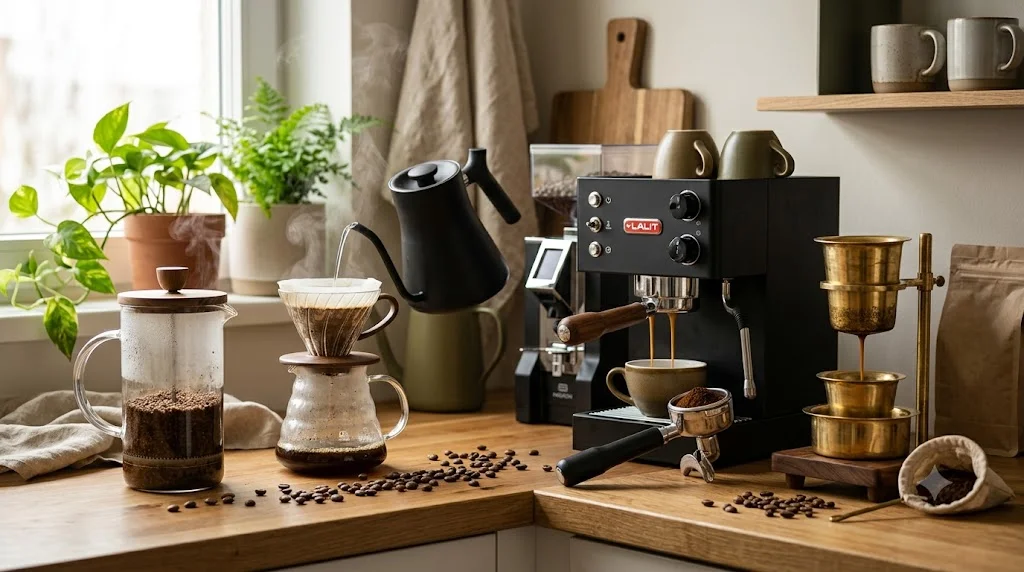
You can have freshly roasted, high-quality coffee beans and still end up with a disappointing cup.
The reason? Your coffee grind size may be wrong.
Grinding coffee is more than simply turning whole beans into smaller pieces. The size of those particles directly affects how quickly water extracts flavor from the coffee. Choose the right grind size, and your coffee can taste balanced, aromatic, and full of character. Choose the wrong one, and the same beans can taste bitter, weak, sour, or flat.
Understanding coffee grind size is one of the easiest ways to improve your brewing at home.
Whether you use a French press, South Indian filter, pour-over, espresso machine, or cold brew, this guide will help you understand exactly how fine or coarse your coffee should be.
What Is Coffee Grind Size?
Coffee grind size refers to how finely or coarsely coffee beans are ground before brewing.
In simple terms:
- Coarse grind = larger coffee particles
- Medium grind = medium-sized particles
- Fine grind = small coffee particles
- Extra-fine grind = almost powder-like particles
The right grind depends mainly on your brewing method.
Why does this matter?
When hot water comes into contact with ground coffee, it extracts compounds that create the aroma, flavor, sweetness, acidity, and body of your cup.
Smaller particles have more surface area exposed to water, so they generally extract faster.
Larger particles have less surface area, so they generally extract more slowly.
This is why an espresso requires a much finer grind than a French press.
Why Coffee Grind Size Matters
Imagine making two cups using the exact same coffee beans.
In one cup, the coffee tastes rich, sweet, and balanced.
In the other, it tastes harsh or watery.
The difference may not be the beans at all. It could be the grind.
Coffee grind size influences three important things:
1. Extraction
Extraction is the process through which water pulls soluble compounds from coffee grounds.
If the grind is too fine for your brewing method, extraction can happen too quickly.
This can create an overly bitter or harsh cup.
If the grind is too coarse, extraction may happen too slowly, resulting in a weak or sour-tasting coffee.

2. Brewing Time
Grind size also affects how quickly water moves through the coffee.
A finer grind slows water movement because the particles are packed more tightly together.
A coarser grind allows water to move more freely.
This is particularly important for methods such as espresso and pour-over coffee.
3. Flavor
Small changes in grind size can change the way your coffee tastes.
A properly adjusted grind can help bring out the natural characteristics of the beans, whether they are chocolatey, nutty, fruity, floral, or bold.
This is one reason specialty coffee drinkers pay close attention to grind size.
Coffee Grind Size Chart
Here is a simple starting point for choosing the right grind for popular brewing methods:
| Brewing Method | Recommended Grind | Texture |
|---|---|---|
| French Press | Coarse | Rough, similar to sea salt |
| Cold Brew | Coarse | Chunky and coarse |
| South Indian Filter | Medium-Fine | Fine but slightly granular |
| Pour Over / V60 | Medium-Fine | Similar to table salt |
| Drip Coffee | Medium | Similar to sand |
| AeroPress | Fine to Medium-Fine | Fine, depending on recipe |
| Espresso | Fine | Smooth and powdery |
| Turkish Coffee | Extra Fine | Almost flour-like |
These are starting points rather than strict rules. Your grinder, coffee beans, water, recipe, and brewing time can all influence the final result.
Coarse Grind: When Should You Use It?
Coarse coffee grounds have large particles and are commonly used for longer brewing methods.
Best for:
- French press
- Cold brew
- Some immersion brewing methods
French press coffee, for example, typically benefits from a coarse grind because the coffee remains in contact with water for several minutes.
A very fine grind can make French press coffee muddy and difficult to filter.
For cold brew, coarse grounds are also useful because the coffee is usually steeped for many hours.
What does coarse-ground coffee taste like?
When brewed correctly, coarse-ground coffee can produce a smooth, full-bodied cup.
However, if your coffee tastes noticeably weak or sour, your grind may be too coarse or your brewing time may be too short.
Medium Grind: A Versatile Coffee Grind Size
A medium grind sits between coarse and fine.
It is commonly associated with drip coffee makers and some brewing methods that use moderate contact time.
The texture is often compared to regular sand.
Medium grind can be a good starting point when you’re experimenting with different brewing techniques.
However, the exact grind setting can vary depending on your equipment.
If your coffee tastes weak and watery, try grinding slightly finer.
If it tastes bitter or overly intense, try going slightly coarser.
Medium-Fine Grind: Great for Pour Over and Filter Coffee
Medium-fine coffee grounds are commonly used for brewing methods where water passes through the coffee relatively quickly.
This includes many pour-over recipes.
For a pour-over coffee maker, the grind needs to allow water to flow through the coffee at an appropriate rate while giving it enough contact time for proper extraction.
If your coffee drains too quickly and tastes weak, a slightly finer grind may help.
If the water takes too long to pass through and the coffee tastes bitter, try going slightly coarser.
Small adjustments can make a surprisingly large difference.
Fine Grind: Essential for Espresso
Espresso requires a fine grind because the brewing process is fast and uses pressure.
The coffee is ground into small particles, packed into a compact coffee puck, and water is pushed through it under pressure.
Because the brewing time is short, a fine grind provides enough surface area for effective extraction.
If espresso is flowing too quickly and tastes thin or sour, the grind may be too coarse.
If the espresso is flowing extremely slowly and tastes bitter, the grind may be too fine.
This is why espresso preparation often involves small grind adjustments.
Extra-Fine Grind: For Turkish Coffee
Turkish coffee requires an exceptionally fine grind.
The coffee is ground almost to the consistency of flour and brewed directly in water without conventional filtration.
Because the grounds remain in the cup, they need to be extremely fine.
This grind is not suitable for most standard brewing methods.
Using Turkish-style grounds in a French press, for example, can result in a very muddy cup.
How to Choose the Right Coffee Grind Size
The easiest approach is to start with the recommended grind for your brewing method and then adjust based on taste.
Think of it as a simple process:
Choose your brewing method → select a starting grind → brew → taste → adjust.
If the coffee tastes:
Sour or sharp
Your coffee may be under-extracted.
Try:
- Grinding slightly finer
- Increasing brewing time
- Increasing water temperature slightly
Bitter or harsh
Your coffee may be over-extracted.
Try:
- Grinding slightly coarser
- Reducing brewing time
- Adjusting your brewing recipe
Weak or watery
The coffee may not have extracted enough flavor.
Try:
- Grinding slightly finer
- Increasing the coffee-to-water ratio
- Increasing brewing time
Too strong or heavy
Try:
- Grinding slightly coarser
- Adjusting the coffee-to-water ratio
- Reducing brewing time
Remember that flavor problems are not always caused by grind size. Water quality, coffee freshness, dose, temperature, and brewing technique also matter.
Does Freshly Roasted Coffee Need a Different Grind?
The freshness and roast profile of your coffee can influence how it behaves during brewing.
Freshly roasted coffee contains gases released during roasting. This is one reason coffee is often allowed to rest for a period after roasting before brewing.
Different coffees can also respond differently to the same grinder setting.
A high-quality grinder gives you more control because it can produce a more consistent particle size.
This consistency matters because a mixture of very fine and very coarse particles can make extraction less predictable.
Why Grinder Quality Matters
Your grinder can be just as important as your coffee beans.
A poor-quality grinder may produce a mixture of particle sizes, commonly known as an uneven grind.
For example, your “medium” grind might contain:
- Very fine particles
- Medium particles
- Large chunks
This can create inconsistent extraction.
Some particles may become over-extracted while others remain under-extracted.
A good burr grinder generally provides greater control and consistency than a basic blade grinder.
If you’re serious about improving your coffee, upgrading your grinder can make a noticeable difference.
Blade Grinder vs Burr Grinder
Blade Grinder
Blade grinders chop coffee beans using a rapidly rotating blade.
They are generally affordable and simple to use.
However, achieving a consistent grind size can be difficult.
Burr Grinder
Burr grinders crush coffee beans between two grinding surfaces.
They offer greater control over particle size and are generally preferred by coffee enthusiasts.
For brewing methods where grind precision matters, a burr grinder can be a worthwhile investment.
Should You Grind Coffee Before Brewing?
Whenever possible, grind your beans shortly before brewing.
Whole coffee beans generally preserve their aroma and flavor better than already-ground coffee because grinding dramatically increases the surface area exposed to air.
Once coffee is ground, aroma compounds can dissipate more quickly.
This is why freshly grinding your beans can contribute to a more aromatic and flavorful cup.
Cherritos Coffee focuses on freshly roasted coffee in small batches, with coffees sourced from Indian estates and roasted to highlight the character of the beans.
Coffee Grind Size for Different Cherritos Brewing Styles
The best grind setting depends on how you prepare your Cherritos coffee.
For a French press, begin with a coarse grind to support the longer immersion process.
For South Indian filter coffee, start around a medium-fine setting and adjust according to your equipment and brewing recipe.
For pour-over, a medium-fine grind is a useful starting point.
For espresso, use a fine grind and make small adjustments according to extraction speed and taste.
Cherritos currently offers several coffees across different roast styles, including Heritage Select, Highland Reserve, Western Crest, Monsoon Malabar, Vienna Roast, Coorg Mud Blend, Signature Blend, and Millennium Blend.
The same grind setting may not produce identical results with every coffee, so treat your first brew as a starting point rather than a final recipe.
5 Common Coffee Grinding Mistakes
1. Using the Same Grind for Every Brewing Method
Espresso and French press require very different grind sizes.
Always choose your grind based on the brewing method.
2. Grinding Too Far in Advance
Pre-ground coffee can lose aroma and freshness more quickly.
Whenever possible, grind immediately before brewing.
3. Changing Too Many Variables at Once
If your coffee tastes wrong, don’t immediately change everything.
Adjust one variable at a time.
Start with grind size.
4. Ignoring Taste
Grind charts are useful, but your taste is the final test.
Coffee beans, grinders, water, altitude, brewing equipment, and recipes all behave differently.
5. Assuming Finer Always Means Stronger
A finer grind doesn’t simply mean “stronger coffee.”
It changes the rate of extraction.
If you grind too fine, you can extract undesirable compounds and create a bitter or harsh cup.
The Golden Rule: Adjust Gradually
One of the best habits you can develop as a home brewer is making small adjustments.
Don’t move your grinder from very coarse to extremely fine after one disappointing cup.
Instead, make a small change and brew again.
Take notes if you’re experimenting.
Record:
- Coffee used
- Grind setting
- Coffee dose
- Water amount
- Water temperature
- Brewing time
- Final taste
Over time, you’ll discover the settings that work best for your favorite coffee.
Understanding coffee grind size can completely change your home brewing experience.
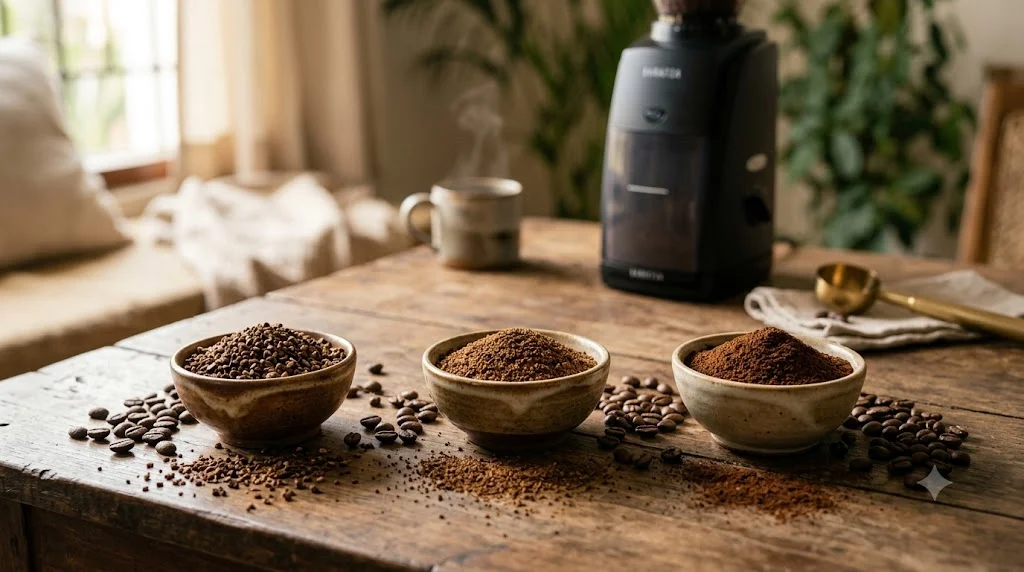
The right grind helps control extraction, brewing time, and ultimately the flavor in your cup.
As a simple starting point:
French press → coarse
Cold brew → coarse
South Indian filter → medium-fine
Pour over → medium-fine
Drip coffee → medium
Espresso → fine
Turkish coffee → extra fine
But don’t be afraid to experiment.
Coffee is not a one-setting-fits-all experience. The ideal grind depends on your brewing method, coffee, grinder, water, and personal taste.
Start with the recommended setting, taste your coffee, and make small adjustments.
Because once you understand how grind size works, you’re no longer simply brewing coffee.
You’re learning how to make the most out of every bean.
Explore More Coffee Guides from Cherritos
If you want to learn more about brewing, coffee flavor, and specialty coffee, explore the Cherritos Coffee learning collection for guides on brewing methods, tasting, coffee basics, and coffee stories.


