
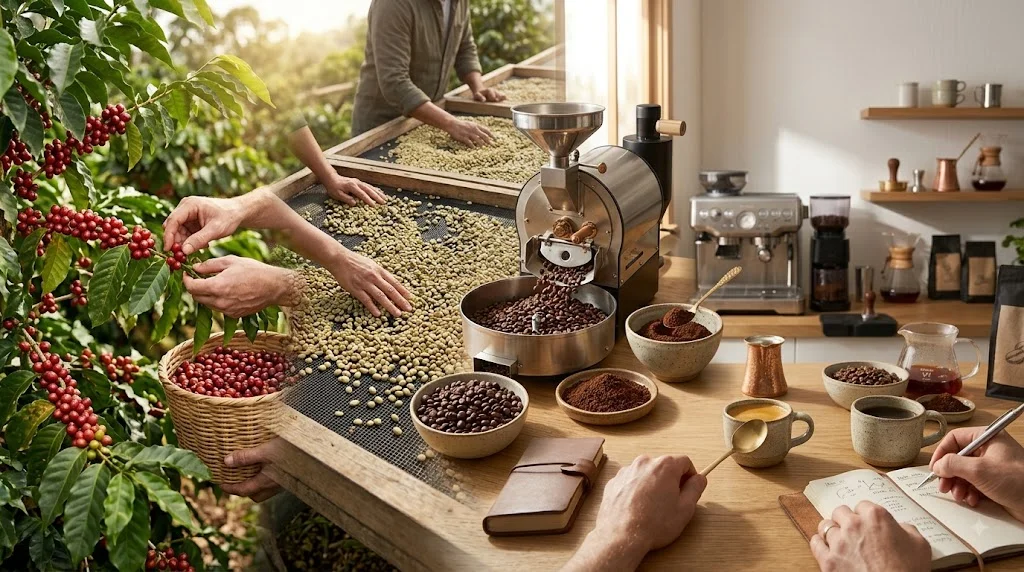
You wake up, make your coffee, take a sip—and enjoy the finished cup.
But have you ever wondered what actually happens before coffee reaches your cup?
That morning coffee has already travelled through an incredible journey.
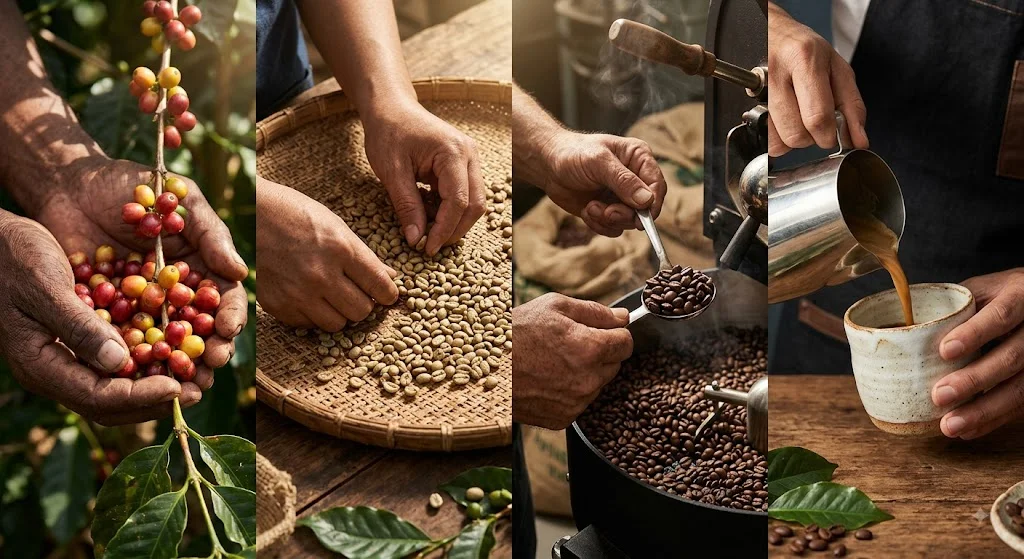
It starts as a coffee cherry growing on a plant. Then it is harvested, processed, dried, sorted, roasted, ground, and finally brewed.
Every step can influence the flavour, aroma, body, and overall experience of the coffee you drink.
This journey is often called from bean to cup.
Understanding it doesn’t require you to become a coffee expert. In fact, once you know what happens behind the scenes, you may start appreciating your everyday coffee a little differently.
Let’s follow the journey step by step.
1. It Starts With a Coffee Plant
Before coffee becomes the roasted beans you see in a bag, it grows as a fruit.
Coffee plants are evergreen plants that produce small fruits commonly called coffee cherries.
Inside each cherry are usually two seeds.
These seeds are what eventually become the coffee beans we roast and brew.
Coffee plants generally grow in regions with suitable tropical or subtropical climates. Factors such as altitude, rainfall, temperature, soil, and sunlight can influence how the coffee develops.
This is one reason coffee from different regions can taste so different.
A coffee grown in one environment may develop very different characteristics from one grown somewhere else.
2. Coffee Cherries Take Time to Develop
Coffee cherries do not become ready overnight.
The fruit develops gradually and changes colour as it ripens.
Depending on the variety and growing conditions, ripe cherries may develop a deep red, yellow, or other characteristic colour.
Farmers carefully monitor the crop because harvesting too early or too late can affect quality.
A ripe cherry can contain the right balance of sugars, acids, and other compounds that influence the eventual coffee flavour.
That means the journey to a good cup starts long before roasting.
3. Harvesting the Coffee Cherries
Once the cherries are ready, they need to be harvested.
There are different approaches to harvesting.
Selective Picking
Workers pick ripe cherries individually, leaving unripe fruit on the plant.
This approach can allow for better control over ripeness but requires more labour.
Strip Picking
Cherries are removed from branches more broadly, which can be faster but may result in cherries at different stages of ripeness being collected together.
The harvesting method depends on the farm, region, terrain, coffee variety, and production practices.
After harvesting, the cherries need to be processed relatively quickly.
4. Processing Turns Fruit Into Coffee Seeds
This is one of the most important stages in the coffee journey.
The coffee cherry has to be separated from the seeds inside.
There are several processing methods, but three commonly discussed approaches are:
- Washed
- Natural
- Honey or pulped natural
Each method can influence the flavour characteristics of the finished coffee.
Washed Processing
In washed processing, the fruit is removed from the coffee seed before the beans are dried.
The coffee is typically separated from the fruit using equipment and may undergo fermentation to help remove remaining material.
The beans are then washed and dried.
Washed coffees are often associated with clean and clearly defined flavour profiles.
Natural Processing
Natural processing leaves the coffee cherry largely intact while the coffee dries.
The cherries are carefully spread out and dried, often being turned regularly to encourage even drying.
Once sufficiently dry, the dried fruit is removed from the beans.
Natural coffees can sometimes show pronounced fruity, sweet, and complex characteristics.
Honey Processing
Honey processing sits somewhere between washed and natural processing.
The outer skin of the cherry is removed, while some of the sticky fruit material remains around the seed during drying.
The amount of remaining fruit can vary.
This can create a range of flavour characteristics depending on the specific processing approach.
5. Drying the Coffee
After processing, coffee needs to be dried to a suitable moisture level before it can be stored and transported.
Drying can happen in several ways.
Coffee may be:
- Spread on raised drying beds
- Dried on patios
- Mechanically dried
- Or processed using a combination of methods
The drying stage requires care.
Coffee that dries unevenly or too quickly can develop quality problems.
Good drying helps prepare the coffee for the next stages of its journey.
6. Sorting and Grading
Once the coffee has been dried, it is sorted and prepared for further processing.
Defective beans and unwanted materials may be removed.
Coffee can be evaluated based on various characteristics, including:
- Bean size
- Density
- Appearance
- Moisture
- Defects
- Cup quality
Specialty coffee goes through detailed evaluation and quality assessment.
The goal is to identify coffees with desirable characteristics and reduce unwanted defects.
This is one of the stages where careful quality control becomes particularly important.
7. Green Coffee Is Ready for Its Next Journey
After processing and preparation, the coffee is often referred to as green coffee.
It does not look anything like the dark brown beans you see in a coffee bag.
Green coffee is the raw, unroasted form of the coffee seed.
At this stage, the coffee may be transported from its producing region to another location where it will eventually be roasted.
The green coffee still has enormous flavour potential.
But it needs another major transformation.

8. Roasting Transforms the Coffee
This is where the green coffee becomes the familiar brown coffee bean.
Roasting uses heat to transform the physical and chemical properties of the coffee.
During roasting:
- Beans change colour
- Moisture decreases
- The beans expand
- Aromatic compounds develop
- Sugars undergo chemical changes
- Acidity and flavour characteristics evolve
Roasting is both a science and a craft.
Small changes in temperature and time can influence the final flavour.
Light, Medium, and Dark Roasts
Roast level can influence how coffee tastes.
Light Roast
Lightly roasted coffee often highlights more of the coffee’s origin characteristics.
You may notice:
- Fruit
- Floral notes
- Citrus
- Bright acidity
Medium Roast
Medium roasts often offer a balance between origin characteristics and roast flavours.
Common notes can include:
- Caramel
- Chocolate
- Nuts
- Fruit
Dark Roast
Dark roasting generally creates stronger roast characteristics.
You may notice:
- Cocoa
- Toasted flavours
- Dark chocolate
- Smoke
- Bitterness
However, roast levels are not absolute categories, and flavour depends on much more than roast colour alone.
9. Degassing After Roasting
Freshly roasted coffee contains gases, including carbon dioxide, that are released after roasting.
This process is known as degassing.
If you have ever opened a freshly roasted coffee bag and noticed gas escaping, you have seen part of this process.
Roasters often use packaging with one-way valves that allow gases to escape while helping prevent outside air from entering.
The timing of brewing can influence the flavour you experience.
Coffee needs some time to release gases, although the ideal period varies depending on the coffee and brewing method.
10. Grinding the Coffee
The next step is grinding.
This may seem simple, but grind size has a major impact on brewing.
Coffee can be ground differently depending on the brewing method.
Coarse Grind
Often suitable for methods such as French press and some cold brew preparations.
Medium Grind
Commonly used for drip coffee and some pour-over methods.
Fine Grind
Generally used for espresso and certain traditional brewing methods.
The goal is to create a grind size that allows water to extract the coffee appropriately.
This is why freshly grinding coffee immediately before brewing can be so useful.
11. Brewing Turns Coffee Grounds Into Your Drink
Now the journey finally reaches your kitchen.
Water interacts with the coffee grounds and extracts soluble compounds.
This process creates the coffee you actually drink.
But brewing is not simply “add water to coffee.”
Several variables affect the result.
Water Temperature
Temperature influences extraction.
Grind Size
The size of the coffee particles affects how quickly water moves through and extracts them.
Coffee-to-Water Ratio
The amount of coffee relative to water affects the concentration of the final drink.
Brewing Time
Longer or shorter contact times can change the flavour.
Brewing Method
Pour-over, French press, espresso, South Indian filter coffee, AeroPress, and other methods all create different experiences.
12. The Same Bean Can Taste Completely Different
Here’s one of the most fascinating things about coffee.
You can take the same beans and brew them using different methods—and get noticeably different results.
For example, a coffee may taste:
Bright and clean as a pour-over.
Rich and full-bodied as a French press.
Concentrated and intense as an espresso.
The coffee hasn’t changed.
The brewing process has.
This is why experimenting with brewing methods can be so rewarding.
13. From Coffee Farm to Your Kitchen
The complete journey can be simplified like this:
Coffee Plant
↓
Coffee Cherry
↓
Harvesting
↓
Processing
↓
Drying
↓
Sorting & Grading
↓
Green Coffee
↓
Roasting
↓
Degassing
↓
Grinding
↓
Brewing
↓
Your Cup
That’s a remarkable journey for something many of us drink every morning without thinking twice.
What Has the Biggest Impact on Coffee Flavour?
Every stage matters, but several factors are particularly important.
Origin
Where the coffee grows can influence its flavour.
Altitude, climate, soil, rainfall, and farming practices all contribute.
Variety
Different coffee varieties can have different flavour characteristics and growing requirements.
Processing
Washed, natural, and honey processing can produce different flavour profiles.
Roasting
Roast development influences aroma, sweetness, acidity, body, and roast character.
Grinding
Grind size affects extraction.
Brewing
Water, temperature, ratio, time, and technique all influence the final cup.
This is why coffee can be so complex.
It isn’t one ingredient behaving in one predictable way.
It’s a chain of decisions.
Why Specialty Coffee Pays Attention to the Journey
Specialty coffee places strong emphasis on quality throughout the supply chain.
The goal isn’t simply to roast a bean and make it taste good.
Attention can be paid to:
- Farming
- Harvesting
- Processing
- Traceability
- Quality assessment
- Roasting
- Brewing
When these stages work together, the unique characteristics of the coffee can become more noticeable.
That might mean discovering a coffee with notes of berries, citrus, chocolate, caramel, flowers, or nuts.
Instead of tasting simply “coffee,” you may start noticing the story inside the cup.
How You Can Experience the Difference at Home
You don’t need professional equipment to understand the bean-to-cup journey.
Try a simple experiment.
Buy two coffees from different origins.
Use the same brewing method for both.
Keep your:
- Coffee-to-water ratio
- Grind size
- Water temperature
- Brewing time
as consistent as possible.
Then taste them side by side.
Pay attention to:
Aroma
What do you smell before drinking?
Acidity
Does it taste bright or lively?
Sweetness
Can you notice caramel, fruit, chocolate, or other sweet characteristics?
Body
Does the coffee feel light, creamy, or heavy?
Aftertaste
What flavours remain after swallowing?
You may be surprised by how different two coffees can taste.
The Journey Doesn’t End at Brewing
Even after brewing, the coffee experience continues.
How quickly you drink it, what you eat with it, the cup you use, and even the environment can influence how you perceive the coffee.
A coffee enjoyed quietly on a weekend morning can feel completely different from the same coffee consumed quickly before work.
The bean-to-cup journey is therefore both physical and personal.
The coffee travels a long distance.
Then it becomes part of your own moment.
The next time you hold a cup of coffee, remember that it started as a fruit growing on a coffee plant.
Someone cultivated the plant.
Someone harvested the cherries.
The fruit was processed.
The beans were dried and sorted.
The green coffee travelled.
A roaster transformed it with heat.
You—or someone else—ground it.
Water extracted its flavours.
And finally, it reached your cup.
That is the story from bean to cup.
Understanding this journey makes coffee more than just a drink.
It becomes an appreciation of farming, nature, craftsmanship, science, and culture—all coming together in one small cup.
So the next time you take that first sip, slow down for a second.
Notice the aroma.
Notice the flavour.
Notice the texture.
And remember:
Every cup has a journey behind it.


