
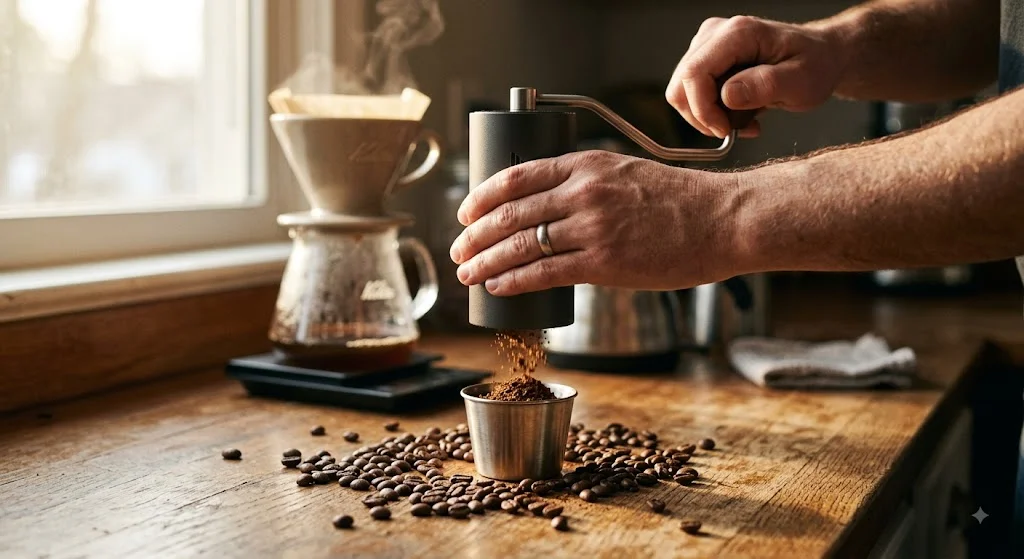
Walk into a coffee shop or browse an online coffee store and you will quickly come across the same question:
Should you buy whole coffee beans or ground coffee?
At first, the choice seems simple.
Whole beans look fresher and more premium, while ground coffee is convenient and ready to brew. But the difference goes beyond convenience.
The way coffee is stored, ground, brewed, and consumed can affect its aroma, flavour, freshness, and overall experience.
So, when comparing coffee beans vs ground coffee, which one is actually better?
The short answer is:
Whole coffee beans generally offer better control and freshness, while ground coffee offers convenience and simplicity.
But that does not mean whole beans are automatically the right choice for everyone.
The best option depends on your brewing method, equipment, routine, budget, and how much time you want to spend making coffee.
Let’s break down the differences so you can choose confidently.
Coffee Beans vs Ground Coffee: What’s the Difference?
The difference is straightforward.
Whole coffee beans are roasted coffee beans that have not yet been ground. You grind them yourself immediately before brewing.
Ground coffee consists of roasted beans that have already been ground to a particular size before packaging.
Both can make excellent coffee.
The biggest difference is how long the coffee has been exposed to air after grinding.
Once coffee is ground, its surface area increases dramatically. This makes it easier for aromatic compounds to escape and for the coffee to interact with oxygen.
That is why grinding shortly before brewing is generally preferred when freshness and flavour are priorities.
Why Freshness Matters
Coffee is full of aromatic compounds.
These compounds contribute to the flavours and aromas you experience in your cup.
After roasting, coffee gradually changes as it interacts with its environment.
Exposure to:
- Oxygen
- Moisture
- Heat
- Light
can gradually affect freshness.
Grinding accelerates this process because a much larger surface area is exposed to air.
This is one of the biggest advantages of buying whole beans.
You can keep the beans whole until you are ready to brew and grind only the amount you need.

Whole Coffee Beans: The Advantages
Whole beans are often the preferred choice for people who want maximum control over their coffee.
1. Better Freshness
One of the biggest benefits is being able to grind immediately before brewing.
Freshly ground coffee can provide a more aromatic and vibrant brewing experience.
You get to release the coffee’s aroma at the exact moment you are preparing your cup.
2. More Control Over Grind Size
Different brewing methods require different grind sizes.
With whole beans, you can adjust your grind depending on what you are making.
For example:
| Brewing Method | Typical Grind |
|---|---|
| French Press | Coarse |
| Cold Brew | Coarse |
| Pour Over | Medium to Medium-Fine |
| Drip Coffee | Medium |
| Espresso | Fine |
| South Indian Filter | Fine |
Having control over grind size means you can experiment and fine-tune your coffee.
3. More Brewing Flexibility
Imagine buying one bag of whole beans.
On Monday, you make French press.
On Wednesday, you make pour-over.
On Saturday, you prepare espresso.
With whole beans, you can adjust the grind to suit each method.
Ground coffee does not offer the same flexibility unless it has been specifically ground for the brewing method you are using.
4. A Better Coffee-Making Experience
For some people, grinding coffee is part of the enjoyment.
You hear the grinder.
You smell the freshly ground coffee.
You measure your beans.
You prepare your brewer.
It turns coffee from a quick beverage into a small ritual.
Of course, not everyone wants that experience.
And that is completely fine.
Ground Coffee: The Advantages
Ground coffee has one major advantage:
Convenience.
And for many people, convenience matters.
1. Faster Brewing
With ground coffee, you can open the packet, measure the coffee, and start brewing.
There is no grinder to set up.
No grinding.
No additional equipment.
This can be particularly useful on busy mornings.
2. No Grinder Required
A good coffee grinder can be an additional expense.
If you are just starting to explore coffee, buying ground coffee lets you enjoy different beans without investing in another appliance.
This makes it a practical option for beginners.
3. Consistent Grind
Commercially ground coffee is often produced using professional equipment designed to achieve a consistent grind.
If you buy coffee specifically ground for your brewing method, you can get a convenient starting point without needing to learn how to adjust a grinder.
4. Great for Simple Brewing
If your daily routine is simple and you use one brewing method regularly, pre-ground coffee can work very well.
For example, if you always use a particular South Indian filter, drip machine, or French press, you can buy coffee ground appropriately for that method.
Coffee Beans vs Ground Coffee: Which Tastes Better?
This is where things become interesting.
Whole beans do not automatically taste better simply because they are whole.
The biggest advantage is fresh grinding.
A freshly ground coffee can retain more of the aroma and flavour characteristics you want from the beans.
But a high-quality pre-ground coffee that has been properly roasted, packaged, stored, and brewed can still produce a very enjoyable cup.
In other words:
Freshness + quality + correct brewing > beans vs ground alone.
Buying whole beans will not magically fix poor brewing.
Likewise, buying ground coffee does not automatically mean your coffee will taste bad.
Which Is Better for Beginners?
If you are new to coffee, ground coffee can be an easy starting point.
You do not have to worry about:
- Choosing a grinder
- Learning grind settings
- Adjusting grind size
- Cleaning another piece of equipment
You can simply choose coffee ground for your preferred brewing method and start brewing.
However, if you are interested in learning more about coffee, whole beans can be a great next step.
They allow you to experiment with grind size and understand how small changes affect your cup.
Which Is Better for Espresso?
If you are making espresso, grind size becomes particularly important.
Espresso generally requires a fine and carefully adjusted grind.
Freshly grinding whole beans gives you much greater control.
You can adjust the grinder based on:
- Extraction time
- Dose
- Coffee flow
- Taste
- Humidity
- Bean characteristics
For serious espresso brewing, whole beans are generally the more flexible option.
Which Is Better for French Press?
French press generally works best with a coarse grind.
Buying whole beans allows you to grind specifically for your French press.
However, pre-ground coffee labelled for French press can also work.
The important thing is using a suitable grind.
If the coffee is too fine, it can produce excessive extraction and make the cup taste harsh or muddy.
Which Is Better for Pour Over?
Pour-over brewing benefits from control.
Small changes to grind size, water temperature, pouring technique, and brewing time can change the final cup.
That makes whole beans particularly attractive to pour-over enthusiasts.
Grinding just before brewing also allows you to experience the coffee’s aroma during preparation.
If convenience matters more than experimentation, however, good-quality pre-ground coffee can still work.
Which Is Better for South Indian Filter Coffee?
For South Indian filter coffee, finely ground coffee is commonly used.
If you have access to a good grinder, whole beans can give you greater control over freshness and grind size.
But traditionally prepared filter coffee is also commonly made using pre-ground coffee blends designed specifically for the method.
So the choice comes down to preference.
If you want convenience, choose a suitable filter grind.
If you want maximum freshness and control, grind whole beans just before brewing.
Which Is Easier to Store?
Both can be stored properly, but whole beans generally have an advantage because grinding exposes more surface area to air.
Regardless of which type you buy, coffee should be kept:
- In an airtight container
- Away from direct sunlight
- Away from heat
- Away from moisture
- At a stable room temperature
Avoid storing coffee next to your stove or in a humid area.
You also do not need to keep opening a large bag throughout the day.
Buying a manageable quantity and storing it correctly can help maintain quality.
Does Ground Coffee Go Bad Faster?
Ground coffee generally loses freshness faster than whole beans because more surface area is exposed after grinding.
That does not mean ground coffee suddenly becomes unsafe to drink after a particular number of days.
Rather, its aroma and flavour gradually decline.
You may notice that older ground coffee tastes flatter, less aromatic, or less vibrant.
This is why buying smaller quantities can be useful if you do not drink coffee frequently.
Is Whole Bean Coffee More Expensive?
Not necessarily.
Whole beans and ground coffee are available across many different price ranges.
However, if you choose whole beans, remember that you may also need to purchase a grinder.
A basic grinder can be enough for getting started, while coffee enthusiasts may eventually invest in a more precise burr grinder.
So the real cost depends on how far you want to take your coffee hobby.
What About Convenience?
This is probably the biggest reason people choose ground coffee.
Consider two mornings.
Morning A
You wake up early.
You have time.
You weigh your beans, grind them, heat your water, and brew slowly.
The process itself is enjoyable.
Morning B
You wake up late.
You have ten minutes before work.
You want coffee immediately.
Ground coffee may be the obvious winner.
There is no prize for making coffee the complicated way.
The best coffee routine is one that fits your actual life.
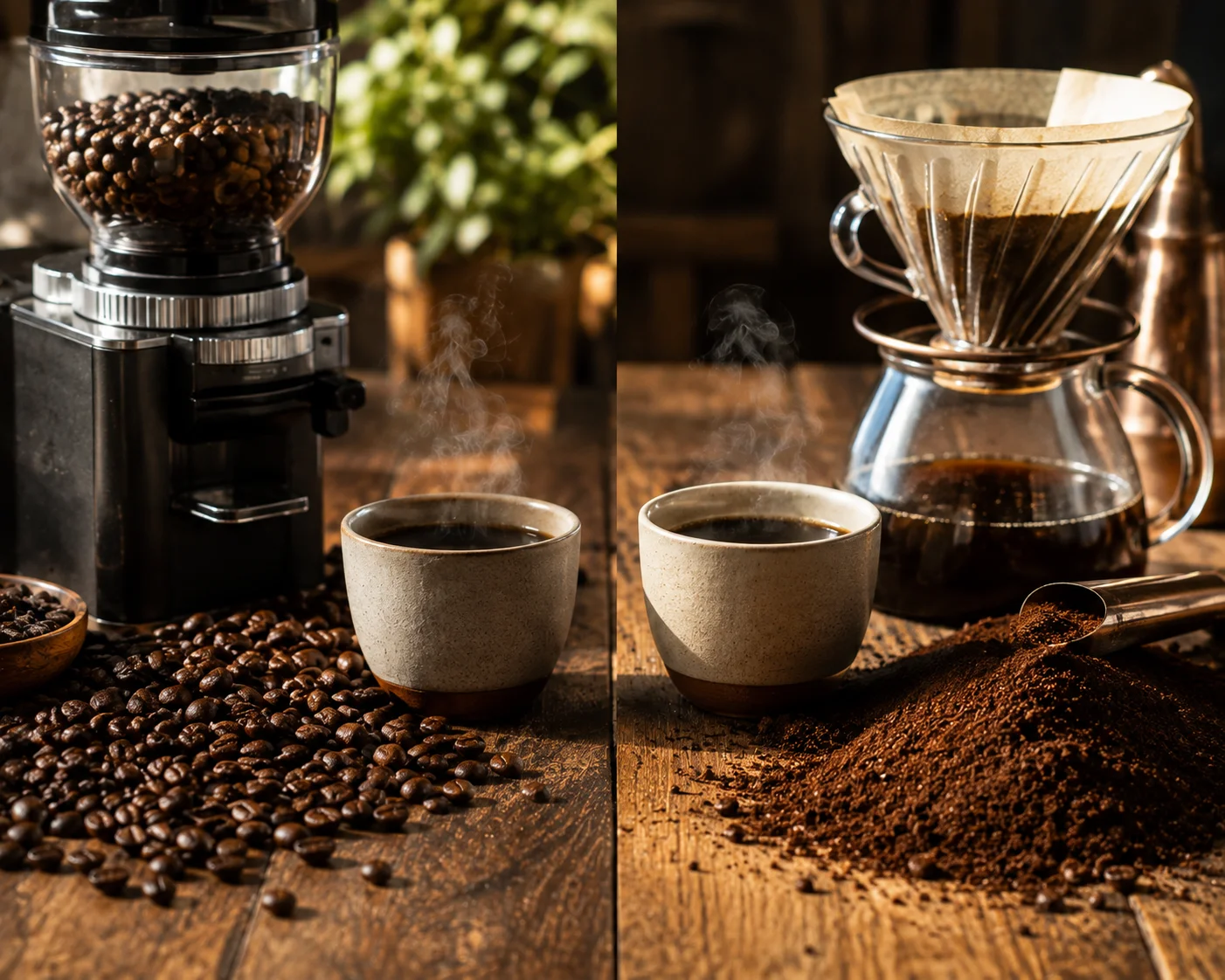
Whole Beans vs Ground Coffee: Quick Comparison
| Feature | Whole Coffee Beans | Ground Coffee |
|---|---|---|
| Freshness | Excellent when freshly ground | Good, but freshness declines faster |
| Convenience | Requires grinding | Very convenient |
| Grind control | Complete control | Limited |
| Brewing flexibility | Excellent | Depends on grind |
| Equipment required | Grinder + brewer | Brewer only |
| Aroma | Strong when freshly ground | Can decline faster |
| Beginner-friendly | Requires learning | Very easy |
| Espresso | Excellent control | Convenient if correctly ground |
| French Press | Excellent control | Good if coarsely ground |
| Pour Over | Excellent control | Good if correctly ground |
| Storage | Generally retains freshness longer after opening | More exposed after grinding |
| Best for | Enthusiasts and fresh brewing | Convenience-focused drinkers |
How to Decide Which One You Need
Still unsure?
Ask yourself five questions.
1. Do You Own a Grinder?
If yes, whole beans become a much more practical option.
If no, ground coffee may be easier.
2. Do You Care About Maximum Freshness?
If freshness is a priority, choose whole beans and grind shortly before brewing.
3. Do You Use Multiple Brewing Methods?
If you switch between espresso, French press, and pour-over, whole beans give you more flexibility.
4. Are Your Mornings Busy?
If speed matters more than experimentation, ground coffee may suit your lifestyle better.
5. Do You Enjoy the Brewing Process?
If you enjoy experimenting and learning, whole beans can make coffee more interesting.
If you simply want a reliable cup, ground coffee may be all you need.
Can You Buy Whole Beans and Grind Them Without an Expensive Grinder?
Absolutely.
You do not need the most expensive grinder on the market to begin.
A basic burr grinder can be a useful starting point for people who want more control over their coffee.
The important thing is being able to produce a reasonably consistent grind.
Blade grinders can work, but they often produce a mixture of fine and coarse particles, making extraction less predictable.
If you are serious about improving your coffee, investing in a decent grinder can often make a bigger difference than buying increasingly expensive beans.
What Should You Choose?
There is no universal winner.
Choose Whole Beans If:
- You care about freshness.
- You own a grinder.
- You enjoy experimenting.
- You use different brewing methods.
- You want control over grind size.
- You enjoy the coffee-making process.
Choose Ground Coffee If:
- You want maximum convenience.
- You do not own a grinder.
- You have a busy morning routine.
- You use one brewing method.
- You are new to coffee.
- You prefer a simple preparation process.
And there is nothing wrong with either choice.
A Simple Upgrade: Buy Less, Grind Fresh
If you currently use ground coffee and want to experiment with whole beans, you do not need to completely change your routine.
Try one small bag.
Choose a coffee you already enjoy.
Buy a simple grinder.
Grind only what you need.
Compare the result with your usual pre-ground coffee.
Pay attention to the aroma first.
Then taste the coffee.
You may notice a difference immediately.
Or you may find that convenience is more important to you.
Both are useful discoveries.
When comparing coffee beans vs ground coffee, the better option depends on what you value most.
Whole beans offer freshness, flexibility, and control.
Ground coffee offers simplicity, speed, and convenience.
If you love experimenting with coffee, whole beans are worth exploring.
If you want a good cup without adding another step to your morning, quality ground coffee can be a perfectly sensible choice.
Ultimately, coffee should fit your life.
You do not need complicated equipment, expensive accessories, or expert-level knowledge to enjoy a good cup.
Start with good coffee, store it properly, use the right grind for your brewing method, and pay attention to what you actually enjoy.
Because the best coffee is not the one that requires the most effort.
It is the one you look forward to drinking.


