
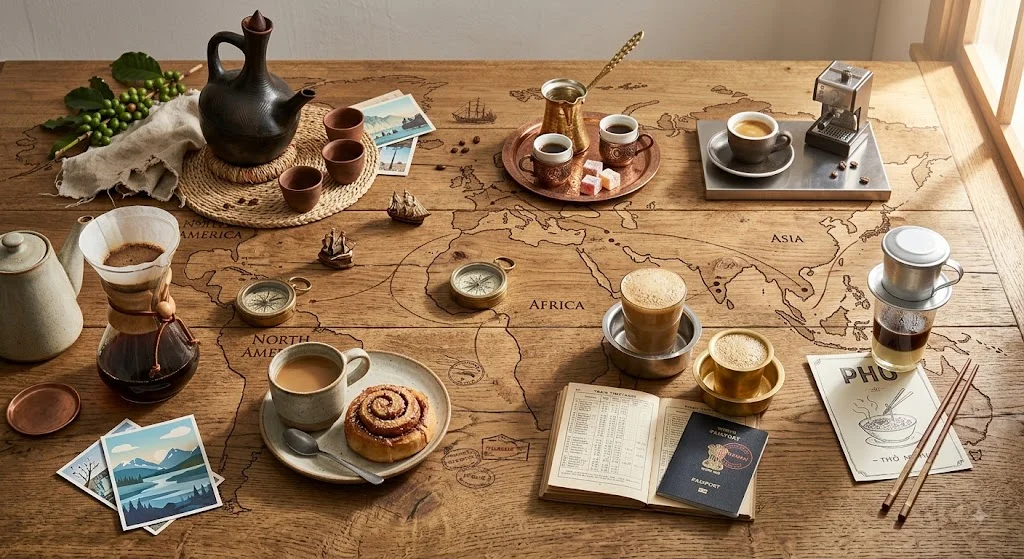
Coffee may start with a bean, but the way people drink it can be completely different from one country to another.
In one place, coffee might be served slowly in a small cup while people catch up with friends. Somewhere else, it might be brewed through a cloth filter, poured over ice, mixed with condensed milk, or enjoyed quickly at a café counter.
That is what makes coffee around the world so fascinating.
Coffee is not simply a morning drink. In many cultures, it is connected to hospitality, family, conversation, tradition, work, celebration, and everyday life.
The beans may travel across continents, but every culture has found its own way to make coffee feel local.
From the traditional coffee ceremonies of Ethiopia to the espresso bars of Italy and the filter coffee traditions of India, let’s take a journey around the world through some of the most interesting coffee cultures.
Why Is Coffee So Different Around the World?
Coffee plants grow in tropical regions, but coffee culture has developed far beyond those growing regions.
As coffee travelled through trade routes and became popular in different countries, people adapted it to their own ingredients, equipment, lifestyles, and traditions.
That is why there is no single definition of a “proper” cup of coffee.
Some cultures prefer strong and concentrated coffee.
Others enjoy lighter and longer brews.
Some add milk.
Some add sugar.
Some add spices.
And some prefer to experience the coffee almost entirely on its own.
The brewing method, roast, serving style, and social setting can all change the experience.
1. Ethiopia — Where Coffee Has Deep Cultural Roots
Ethiopia is widely regarded as one of the birthplaces of coffee, and coffee remains deeply connected to Ethiopian culture.
Traditional Ethiopian coffee preparation is often associated with a coffee ceremony, where green coffee beans are roasted, ground, brewed, and served as part of a social experience.
The ceremony can take time.
And that is precisely the point.
Coffee is not something to rush.
Guests may gather together while the beans are roasted and prepared. The aroma fills the room, and the process becomes part of the occasion.
This is very different from grabbing a takeaway coffee on the way to work.
Here, coffee becomes an opportunity for connection.
The Ethiopian Coffee Ceremony
A traditional ceremony may involve:
- Roasting green coffee beans
- Grinding the roasted beans
- Brewing the coffee in a traditional vessel called a jebena
- Serving the coffee in small cups
- Sharing the experience with guests
The ceremony highlights something that exists in coffee cultures everywhere:
Coffee can bring people together.
2. Italy — The Art of Espresso
When many people imagine Italian coffee, they immediately think of espresso.
And for good reason.
Espresso has become one of the defining features of Italian coffee culture.
An espresso is a small, concentrated coffee brewed by forcing hot water through finely ground coffee under pressure.
But Italian coffee culture is about more than the drink itself.
The café is part of the experience.
A person might stop for a quick espresso, exchange a few words with the barista, and continue with their day.
The experience can be fast, social, and deeply woven into everyday life.
Popular Italian Coffee Drinks
Italy has inspired coffee drinks that are now popular around the world, including:
- Espresso
- Cappuccino
- Caffè latte
- Caffè macchiato
- Caffè Americano
Interestingly, these drinks are not necessarily consumed in the same way or at the same time of day in Italy as they might be elsewhere.
For example, milk-based coffee is strongly associated with breakfast, while espresso can be enjoyed throughout the day.
3. Turkey — Coffee With Tradition
Turkish coffee is famous for its distinctive preparation.
Very finely ground coffee is brewed directly with water, traditionally in a small pot known as a cezve.
Unlike filtered coffee, the grounds remain in the cup after brewing.
The result is a small, strong, rich cup with a distinctive texture.
But Turkish coffee is about more than preparation.
It has an important social and cultural role and has a long history.
Coffee can be served when welcoming guests, during conversations, or as part of social occasions.
A Unique Coffee Tradition
One interesting tradition associated with Turkish coffee is fortune telling using the patterns left by coffee grounds after the cup has been emptied.
Whether you believe in it or simply enjoy the tradition, it shows how coffee can become part of cultural storytelling.
4. India — Filter Coffee and Everyday Comfort
India has a rich and diverse coffee culture.
While coffee-growing regions such as Karnataka, Kerala, and Tamil Nadu are strongly associated with Indian coffee production, South Indian filter coffee has become one of the country’s most recognisable coffee traditions.
It is typically prepared using a metal filter and brewed coffee is combined with hot milk and sugar.
The coffee is traditionally served in a stainless-steel tumbler and dabarah.
The result is rich, aromatic, creamy, and deeply comforting.
For many people, the experience is about more than caffeine.
It can remind them of home.
South Indian Filter Coffee
A traditional preparation commonly involves:
- Finely ground coffee
- A metal filter
- Slow brewing
- Hot milk
- Sugar according to taste
- Serving in a tumbler and dabarah
The coffee can also be poured between the tumbler and dabarah to cool it and create its characteristic froth.
It is a wonderful example of how coffee becomes part of everyday cultural identity.
5. Vietnam — Strong Coffee With Condensed Milk
Vietnam has developed one of the most recognisable coffee styles in the world.
Vietnamese coffee is often prepared using a phin, a small metal filter that sits directly on top of the cup.
The coffee slowly drips through the filter.
One of the most famous versions is cà phê sữa đá, coffee served with sweetened condensed milk and ice.
The result is strong, sweet, creamy, and refreshing.
It is particularly enjoyable in Vietnam’s warm climate.
Why Condensed Milk?
Historically, condensed milk became a practical alternative to fresh milk, which was less readily available in Vietnam.
Over time, the combination became an iconic part of Vietnamese coffee culture.
Today, Vietnamese iced coffee is enjoyed around the world.
6. Japan — Precision and Craft
Japan has a fascinating coffee culture built around precision, presentation, and attention to detail.
Pour-over brewing is particularly popular among specialty coffee enthusiasts.
The process can be slow and deliberate.
Water is carefully poured over the grounds, often in controlled circular movements.
The focus is not simply on producing caffeine.
It is about extracting the flavour of the coffee as carefully as possible.
Japanese Coffee Culture
Japanese coffee culture also includes kissaten—traditional coffee shops that have historically focused on carefully prepared coffee and a quiet atmosphere.
These spaces can feel very different from fast-paced modern cafés.
They encourage customers to sit, slow down, and enjoy the experience.
In that sense, Japanese coffee culture shares something with traditional coffee ceremonies elsewhere:
The process matters.
7. Colombia — Coffee as Part of National Identity
Colombia is one of the world’s best-known coffee-producing countries.
Its mountains, climate, altitude, and coffee-growing traditions have helped make Colombian coffee famous internationally.
Coffee production is deeply connected to rural communities and the country’s identity.
For many consumers around the world, Colombian coffee is associated with balanced, approachable flavours.
Depending on the region and processing method, Colombian coffees can show notes ranging from caramel and chocolate to fruit and citrus.
From Farm to Cup
One of the most interesting aspects of Colombian coffee culture is the connection between the people who grow coffee and the people who drink it.
The journey of a coffee bean involves:
Farm → Harvest → Processing → Drying → Roasting → Grinding → Brewing → Cup
Every stage can influence the final flavour.
That makes Colombian coffee more than a beverage.
It is the result of agriculture, skill, climate, and craftsmanship.
8. Brazil — Coffee as an Everyday Essential
Brazil is one of the world’s largest coffee-producing countries and has a huge domestic coffee culture.
Coffee is deeply integrated into everyday Brazilian life.
A simple cup of filtered coffee can be enjoyed throughout the day.
In many Brazilian homes, coffee is associated with breakfast, conversation, and hospitality.
One traditional preparation is cafezinho, a small, strong, sweet coffee.
It is often served in small cups and can be enjoyed at home, in workplaces, or when welcoming visitors.
The idea is simple:
Make coffee.
Offer coffee.
Share coffee.
9. Greece — Coffee and Long Conversations
Coffee culture in Greece often revolves around sitting down and taking your time.
Greek coffee is prepared in a small pot and served unfiltered, somewhat similar to Turkish coffee.
Another famous drink is the frappé, an iced coffee drink traditionally made using instant coffee, water, and ice, sometimes with milk.
Modern Greek café culture also includes freddo espresso and freddo cappuccino.
What connects many of these drinks is the social experience.
Coffee can be an excuse to sit with friends for a long conversation.
And sometimes, that is exactly what coffee is supposed to be.
10. Sweden — Coffee Breaks as a Ritual
Sweden has a unique relationship with the coffee break.
The Swedish concept of fika is often translated as a coffee break, but the idea goes beyond simply drinking coffee.
Fika is about taking a pause.
It can involve coffee, something sweet to eat, and time spent with friends, family, or colleagues.
In a busy world, the idea of deliberately stopping for a moment is surprisingly meaningful.
Coffee becomes the reason to pause and connect.
It is a reminder that productivity is not everything.
Sometimes a break is part of the day that matters.
11. Portugal — Small, Strong and Social
Portugal has a strong espresso culture.
A small espresso can be ordered throughout the day and is often enjoyed quickly at a café.
You may hear people order a bica, a term commonly used for espresso in Lisbon.
Portuguese coffee culture demonstrates another interesting side of coffee:
You do not need a large drink to create a meaningful ritual.
Sometimes a small cup is enough.
12. Australia — Specialty Coffee and Café Culture
Australia has developed a highly regarded modern café culture.
Espresso-based drinks such as flat whites are particularly associated with Australian and New Zealand coffee culture.
Modern Australian cafés often place strong emphasis on:
- Coffee quality
- Espresso preparation
- Milk texture
- Fresh ingredients
- Café design
- Specialty coffee
The result is a coffee culture that combines the social nature of cafés with increasing interest in specialty coffee and careful preparation.
Coffee Around the World: A Quick Comparison
| Country | Popular Coffee Style | What Makes It Interesting |
|---|---|---|
| Ethiopia | Coffee ceremony | Social tradition and roasting |
| Italy | Espresso | Fast, concentrated café culture |
| Turkey | Turkish coffee | Unfiltered preparation and tradition |
| India | South Indian filter coffee | Strong coffee, milk and tradition |
| Vietnam | Vietnamese iced coffee | Phin filter and condensed milk |
| Japan | Pour-over | Precision and craftsmanship |
| Colombia | Regional coffees | Strong connection to coffee farming |
| Brazil | Cafezinho | Everyday hospitality |
| Greece | Greek coffee, frappé | Relaxed café culture |
| Sweden | Fika | Coffee as a social pause |
| Portugal | Bica | Small espresso and café culture |
| Australia | Flat white | Modern specialty café culture |

What Can We Learn From Coffee Cultures Around the World?
Looking at different coffee traditions reveals something interesting.
There is no single “correct” way to enjoy coffee.
In Ethiopia, the process can be ceremonial.
In Italy, it can be quick.
In Sweden, it can be a deliberate break.
In India, it can be connected to home and tradition.
In Vietnam, it can be sweet and refreshing.
In Japan, it can be precise and thoughtful.
The coffee changes.
The culture changes.
But the underlying idea often remains the same:
Coffee creates a moment.
Sometimes that moment is about connection.
Sometimes it is about slowing down.
Sometimes it is simply about enjoying something delicious.
How Coffee Became So Personal
Modern coffee drinkers have more choices than ever.
You can buy beans from different countries, choose different roast levels, experiment with brewing methods, and explore tasting notes you may never have encountered before.
You can make an Ethiopian-inspired pour-over in your kitchen.
You can prepare an espresso like an Italian café.
You can make Vietnamese-style iced coffee.
You can brew South Indian filter coffee.
This global exchange has made coffee more exciting.
At the same time, it is important to appreciate the traditions behind the drinks.
Every brewing method has a story.
Every coffee culture developed in a particular social and historical context.
And every cup represents a journey that begins long before the coffee reaches your kitchen.
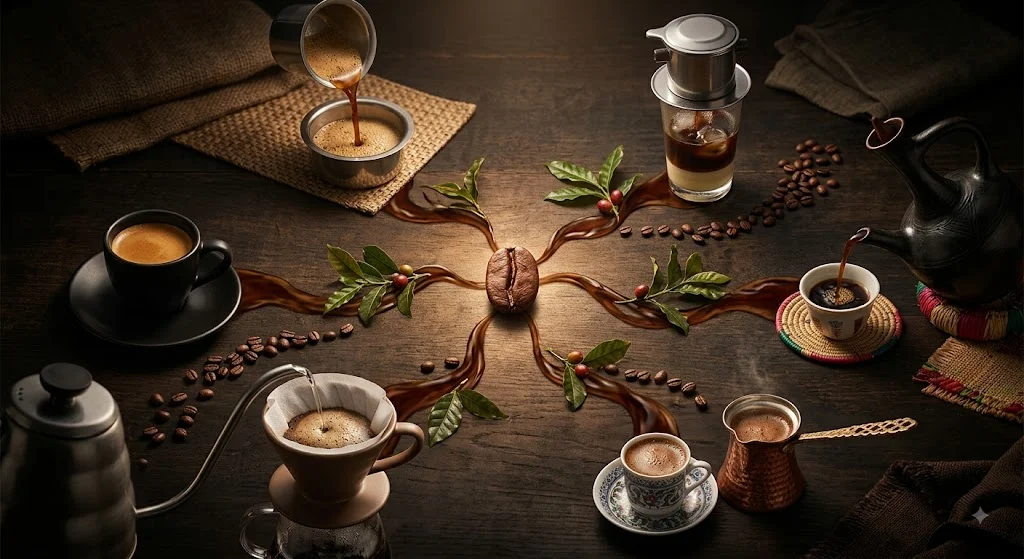
From Coffee Farm to Your Cup
No matter where you drink coffee, the journey begins with the coffee plant.
Coffee cherries are harvested.
The beans are processed and dried.
They are transported and roasted.
Then they are ground and brewed.
At each stage, choices affect the final cup.
That is why two coffees can taste completely different even when they are both made from the same basic ingredient.
Origin matters.
Processing matters.
Roasting matters.
Grinding matters.
Brewing matters.
And, finally, the person drinking it matters too.
Because flavour is personal.
Explore Coffee Beyond Your Usual Cup
If you usually drink the same coffee every day, try exploring another coffee culture.
You could start with something simple.
Try a Vietnamese-style iced coffee on a warm afternoon.
Make South Indian filter coffee on a relaxed weekend.
Try a pour-over inspired by Japanese brewing techniques.
Prepare a strong espresso when you want something quick.
Or simply sit down with a cup and treat it like a Swedish fika.
You do not need to travel around the world to experience different coffee cultures.
Sometimes, you can travel through coffee.
Coffee around the world tells a story of people, places, traditions, and everyday life.
From Ethiopian coffee ceremonies to Italian espresso bars, Indian filter coffee, Vietnamese iced coffee, Japanese pour-over, and Swedish fika, every culture has found its own way to make coffee meaningful.
And perhaps that is what makes coffee so special.
The bean may be the starting point, but the experience is shaped by people.
How they roast it.
How they brew it.
How they serve it.
Who they share it with.
And when they choose to enjoy it.
So the next time you make a cup of coffee, take a moment to think about where that little bean may have travelled—and the many different ways people around the world have turned coffee into part of everyday life.
One bean. Countless cultures. Endless ways to enjoy a cup.


