
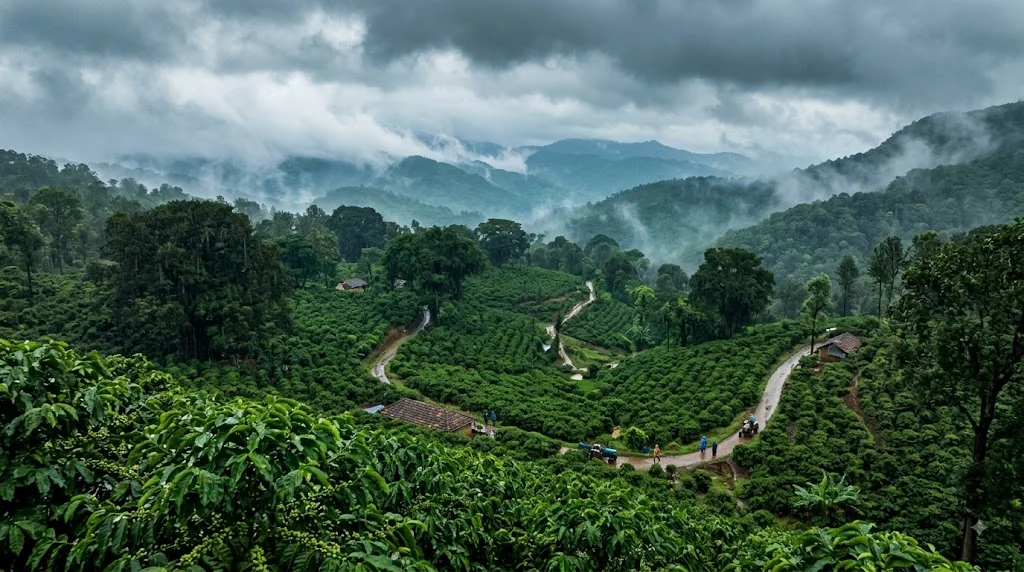
There is something magical about drinking coffee while rain taps against a window.
The world slows down.
The kettle sounds louder.
The aroma feels richer.
And somehow, that familiar cup tastes different.
But India’s relationship with coffee is more interesting than the monsoon-coffee ritual we all know.
India’s coffee story is deeply connected to place, weather, altitude, rainfall, shade, soil, and seasonality.
From the misty hills of Karnataka to the monsoon-influenced coffee landscapes of the Malabar region, the environment surrounding the coffee plant helps shape the raw material that eventually becomes your morning cup.
That is one reason Indian coffee is far more diverse than many people realise.
Cherritos sources coffee from Indian estates and highlights regions including Chikmagalur, Coorg, Bababudangiri, Nilgiris, and Wayanad.
So let’s take a journey from Indian weather to the coffee in your mug.
Coffee Doesn’t Grow in a Vacuum
A coffee plant is influenced by its environment.
Think of it like a story written by geography.
The plant experiences:
- Temperature
- Rainfall
- Sunlight
- Shade
- Elevation
- Soil
- Biodiversity
- Seasonal changes
All these factors contribute to the conditions in which coffee cherries develop.
The result?
Two coffees can taste completely different even when both are Arabica.
India’s Hills: Where Coffee Finds Its Home
Some of India’s most celebrated coffee-growing regions are located in elevated landscapes.
Cherritos describes India’s coffee-growing regions as being shaped by high-altitude plantations, shade-grown cultivation, rich biodiversity, and distinctive soils.
These environments can create slower-growing conditions that allow coffee cherries to develop flavour over time.
This is one reason altitude is frequently discussed in specialty coffee.
But altitude isn’t everything.
It’s one piece of a much larger puzzle.
Chikmagalur: The Heart of Indian Coffee
Chikmagalur is one of India’s best-known coffee regions.
Its association with coffee runs deep, and the surrounding hills provide an environment well suited to coffee cultivation.
For coffee drinkers, the name represents more than geography.
It represents a part of India’s coffee identity.
When you drink coffee sourced from this broader region, you’re tasting the result of farming, climate, elevation, cultivation, processing, and roasting coming together.
Coorg: Coffee Among the Rain and Shade
Coorg, also known as Kodagu, is another iconic coffee-growing region.
Coffee plantations are often associated with lush vegetation, shade trees, rain, and biodiversity.
That landscape is part of what makes Indian coffee visually and culturally distinctive.
Cherritos’ Coorg Mud Blend draws inspiration from traditional South Indian coffee and is positioned around earthy depth, chocolate sweetness, and full body.
This is coffee that feels connected to its landscape.

The Monsoon Has Its Own Coffee Story
Now we arrive at one of the most fascinating examples.
Monsoon Malabar.
This style of coffee is strongly associated with India’s Malabar coast and the monsoon environment.
Cherritos describes its Monsoon Malabar as a medium-dark roast single-estate coffee shaped by the monsoon winds of India’s Malabar coast, with earthy notes, low acidity, and heavy body.
The result is a coffee profile that feels very different from bright, high-acidity coffees many people associate with specialty coffee.
It is earthy.
Deep.
Heavy.
Distinctive.
And unmistakably connected to India.
Why Does Monsoon Coffee Taste Different?
Traditional monsooning exposes coffee beans to humid monsoon conditions after processing.
This changes the physical characteristics of the beans and influences their eventual cup profile.
The resulting coffee is often associated with:
- Lower perceived acidity
- Heavy body
- Earthy character
- Muted brightness
- Distinctive flavour
For someone used to bright, fruity coffee, Monsoon Malabar can be a completely different experience.
And that’s exactly what makes it fascinating.
Rain Changes the Landscape
Think about a coffee estate during monsoon.
The leaves are wet.
The soil is dark.
Mist moves through the hills.
Water runs between plants.
Shade trees create a dense green canopy.
Coffee cherries develop within an ecosystem rather than a factory.
This is important because specialty coffee begins long before roasting.
Cherritos describes its sourcing approach around trusted Indian estates, ethical sourcing, and coffees shaped by regional characteristics.
Shade Matters Too
Coffee plants can benefit from growing under shade trees.
Shade can create a different microclimate around the coffee plants.
Indian coffee estates are often associated with biodiversity and multi-layered plantation environments.
That creates a landscape where coffee grows alongside other plants and wildlife.
For the drinker, this matters because coffee becomes more than a commodity.
It becomes an agricultural product with an origin.
Weather Meets Roasting
The journey doesn’t end at the farm.
Once coffee reaches the roaster, another transformation begins.
Roasting determines how the coffee’s inherent characteristics are expressed.
Cherritos describes its roasting philosophy as focusing on enhancing the coffee’s inherent notes, maintaining balance and smoothness, and avoiding harsh bitterness.
This is where origin and craftsmanship meet.
The roaster doesn’t simply “cook” the coffee.
The goal is to develop the character already present in the bean.
Why Indian Coffee Deserves More Attention
Indian coffee is sometimes overlooked in conversations dominated by famous global origins.
But India has something unique.
It has diversity.
You can explore:
- High-altitude coffees
- Shade-grown estates
- Regional blends
- Single-estate coffees
- Monsooned coffees
- Traditional South Indian coffee
- Modern specialty profiles
There isn’t one “Indian coffee taste.”
There are many.
Coffee and the Indian Monsoon: A Perfect Ritual
Of course, there is also the emotional side.
Rain and coffee belong together.
A rainy afternoon creates the perfect setting for:
- A French press
- South Indian filter coffee
- A rich dark roast
- A warm mug beside a window
- A book
- A conversation
- Ten minutes of doing absolutely nothing
The coffee isn’t necessarily different because it’s raining.
You are different because it’s raining.
And that changes the experience.
Explore India One Cup at a Time
The next time you drink Indian coffee, look beyond the mug.
Ask:
Where was it grown?
What was the climate like?
What was the elevation?
Was it shade-grown?
Was it monsoon influenced?
Was it a single estate or blend?
How was it roasted?
Suddenly, coffee becomes a map.
Cherritos’ approach is built around precisely this connection between Indian origins, sourcing, roasting, and the final cup.
Final Sip
Indian coffee is not one flavour.
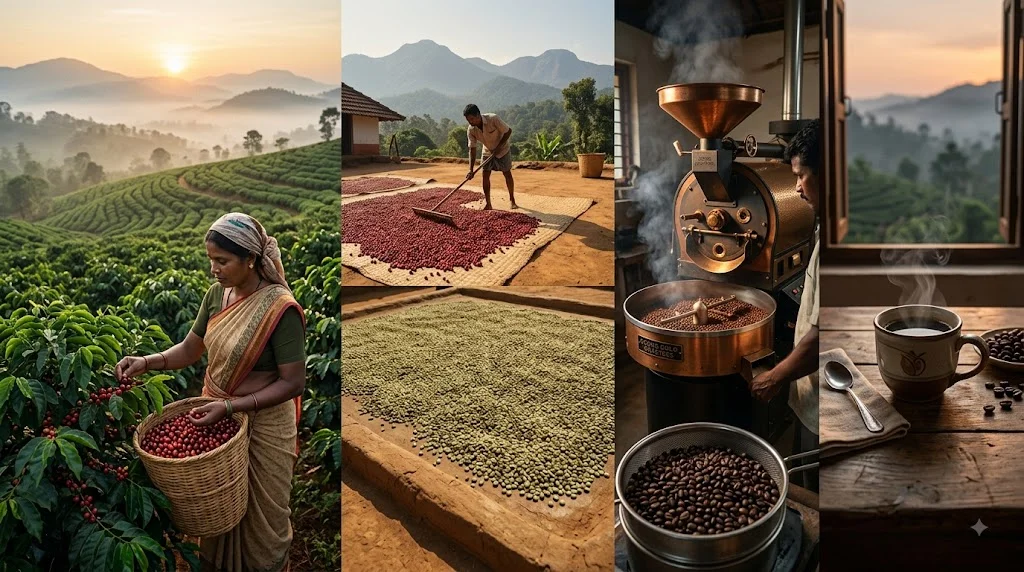
It is a collection of landscapes.
It is misty hills.
Monsoon winds.
Shade trees.
Rich soil.
Careful harvesting.
Roasting rooms.
And finally, the cup sitting quietly beside you.
So the next time rain begins falling outside, make yourself a cup.
But don’t just taste the coffee.
Imagine the place it came from.
That is where Indian coffee becomes more than a drink.
It becomes a story.


